Calculate your estimate
Use measured inputs or actual supplier values. Results update instantly.
Geometric layer volume plus any entered allowance
Density and any extra allowance are illustrative, not product-certified. Verify quantities with your supplier.
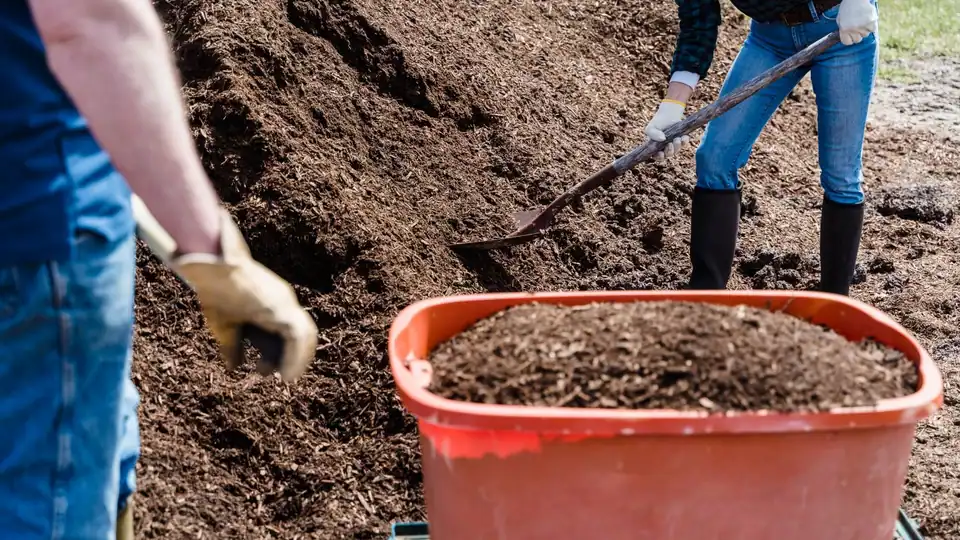
Compost quantity planning begins with garden area and the amount of amendment you intend to add. Unlike fill dirt, compost is selected for its effect on soil and plants; the right depth depends on garden history, product quality and soil testing, not merely on cubic-yard coverage.
Compost cubic yard formula for garden beds
Measure the bed area in square feet and multiply by the specified compost depth in inches. Divide by 324 to convert the resulting volume to cubic yards. For a 300-square-foot area receiving one-half inch of compost, the geometric volume is 300 × 0.5 ÷ 324 ≈ 0.46 cubic yard.
A new planting area receiving a deeper preplant compost layer will require more material. If you have separate sections with different requirements, calculate each one individually and add the volumes. The calculator above also displays the equivalent cubic feet and whole package counts using the volume printed on the bags.
Compost can vary in particle size, moisture, maturity and density. The number of cubic yards describes space; it does not measure nutrient content or tell you whether that quantity is appropriate for a particular soil.
Compost application depths are not universal
Oregon State University Extension's compost guide ↗ distinguishes a new garden-bed amendment from a maintenance application. It discusses 3–4 inches for some new garden beds when incorporated, versus about one-quarter inch to 1 inch for maintenance in existing beds. These recommendations are context-specific and should not be applied automatically to every lawn, raised bed or soil.
Check the soil, plant requirements and the compost's salt and nutrient characteristics before selecting an application rate. Too much compost can be problematic in some situations, particularly where nutrient or salt levels are already high. Colorado State University Extension ↗ notes the value of soil testing and choosing an amendment for a particular objective.
Calculate the intended amendment volume only after the depth has been chosen from suitable horticultural guidance.
Compost volume reference chart
These are geometric quantities for a uniform layer on 100 square feet. The table helps compare a light maintenance addition with a deeper preplant incorporation, not replace soil-testing recommendations.
| Compost layer | Cubic yards | Cubic feet |
|---|---|---|
| 0.25 inch | 0.08 yd³ | 2.08 ft³ |
| 0.5 inch | 0.15 yd³ | 4.17 ft³ |
| 1 inch | 0.31 yd³ | 8.33 ft³ |
| 2 inches | 0.62 yd³ | 16.67 ft³ |
| 3 inches | 0.93 yd³ | 25 ft³ |
| 4 inches | 1.23 yd³ | 33.33 ft³ |
Example: amending a 20 × 15-foot vegetable garden
Consider a 20 × 15-foot vegetable bed with an intended 1-inch compost application. The area is 300 square feet, and the volume is 300 × 1 ÷ 324 = approximately 0.93 cubic yard. In cubic feet, that is 25. A purchase of 1-cubic-foot bags would require 25 whole bags by labeled volume before any additional allowance.
If this is an existing garden that only requires a half-inch addition, the same footprint needs about 0.46 yard, or 12.5 cubic feet. The difference shows why a planned application depth matters more than simply choosing a round number of yards.
Compost may need to be incorporated into soil for some applications, while other uses leave a surface layer. Follow the relevant crop and soil guidance rather than assuming one method works in every context.
Bulk compost versus bagged compost
Bulk compost is commonly sold by cubic yard, while bags may contain one or two cubic feet. Convert cubic yards into 27 cubic feet per yard; then divide by the label's cubic-foot capacity and round up. For 1.5 cubic yards, the equivalent volume is 40.5 cubic feet, or 41 whole 1-cubic-foot bags.
Compare delivered bulk cost and bags using the same volume, including delivery fees, access and handling. The cubic yards to bags calculator performs package conversions and the bulk versus bagged materials guide explores price tradeoffs.
A small, scattered garden may be more practical with bags even when their volume price is higher, while large accessible areas can favor a bulk delivery.
Compost, planting mix and topsoil are different products
Compost is an organic amendment created from decomposed materials. Topsoil contains mineral particles and other constituents used for a growing layer. A commercial raised-bed planting mix may combine topsoil, compost, and other ingredients to meet a planting goal. A pure compost layer should not automatically be treated as the entire fill for a raised garden bed.
Follow product labeling and plant requirements. For the volume of an actual new growing-soil layer, use the topsoil calculator separately. If you add a 2-inch compost amendment before incorporating into existing soil, the compost volume is the applied layer's volume; you do not need to fill the entire incorporation depth with compost.
Compost quality: maturity, salts and contamination
Compost products differ in feedstock, process, maturity, screening and soluble salt content. A visually dark pile alone does not guarantee that it suits delicate plants or a particular planting bed. Ask for product testing, feedstock description, salt content or application guidance when available.
Where agricultural or landscape nutrient management matters, soil and compost testing can avoid adding unnecessary nutrients. The cubic-yard calculator makes no recommendation about compost chemistry or rates; it calculates a volume chosen by the user.
Compost project planning checklist
Measure the area, identify whether it is a new or established bed, review the soil and crop needs, choose a suitable compost product, and select the application depth. Calculate bulk cubic yards, convert to bag count if necessary and verify delivery or pickup logistics.
Do not apply a default waste or compaction percentage from a concrete or gravel calculator. Compost settles and is incorporated differently. For a simple volume-only check, the main cubic yard calculator is available without assigning a weight.
Incorporation depth is not the amount of compost being purchased
Extension guidance may recommend spreading a measured compost layer and then mixing it through a deeper zone of existing soil. For example, an amendment applied two inches thick may be incorporated into the upper several inches of soil. The compost quantity is based on the two-inch application layer, not the entire soil depth that will be mixed.
Confusing incorporation depth with purchase depth can produce a major over-order. A 200-square-foot area with a 2-inch compost layer requires about 1.23 cubic yards. Calculating an 8-inch depth instead would create a 4.94-yard estimate, even though the additional volume represents existing soil that is not being purchased.
Questions to ask about bulk compost quality
A bulk supplier can often explain its feedstock, screening process, maturity, moisture and intended uses. Where available, ask for an analysis covering nutrients, soluble salts or other properties relevant to sensitive plants. A pleasant earthy appearance alone does not establish suitability for every crop or soil.
Compost is not a direct substitute for topsoil in structural grading or for a designed drainage layer. Choose the correct product for the project and calculate the intended amendment volume. For established gardens, reassess soil needs before applying an annual addition rather than assuming the previous year's amount should be repeated.
Frequently Asked Questions
How much compost for 200 square feet at half an inch?
200 × 0.5 ÷ 324 = approximately 0.31 cubic yard, or 8.33 cubic feet.
How many bags of compost make one cubic yard?
One cubic yard equals 27 cubic feet. That is 27 bags of 1 cubic foot each, or 14 whole bags of 2 cubic feet by label volume.
Should I add 3 inches of compost every year?
Not automatically. Established beds often require much less than new preplant applications; consult soil testing and appropriate extension guidance.
Can I fill a raised bed with compost alone?
Pure compost is not generally an automatic substitute for a suitable growing-soil mix. Choose a mix based on crops, drainage and soil needs.
Does compost weigh a fixed number of tons per yard?
No. Bulk density depends on feedstock, moisture and processing. Use volume for area coverage and supplier data when weight is needed.
Is compost the same as mulch?
No. Compost is usually selected as an organic soil amendment; wood mulch is often used as a surface covering. Their preferred applications and depths differ.
References and calculation limits
Exact unit relationships are mathematical; material properties, practical ordering factors and local conditions require supplier or project-specific verification. The following publications support the relevant technical context.
For the site's core formulas and density limitations, see our Calculation Methodology. Need a different tool? Open the cubic yard calculator homepage or browse all related guides.
Related Calculators and Guides
Continue with a material-specific estimate, convert units, or review the calculation behind your result.