Project Volume Calculator
Enter measurements to get an instant estimate. No sign-up needed.
Geometric volume plus any chosen allowance
Illustrative normal-weight cured concrete density. Ready-mix order volume is not converted from this density. Allowances and costs are estimates; verify supplier units and field conditions.
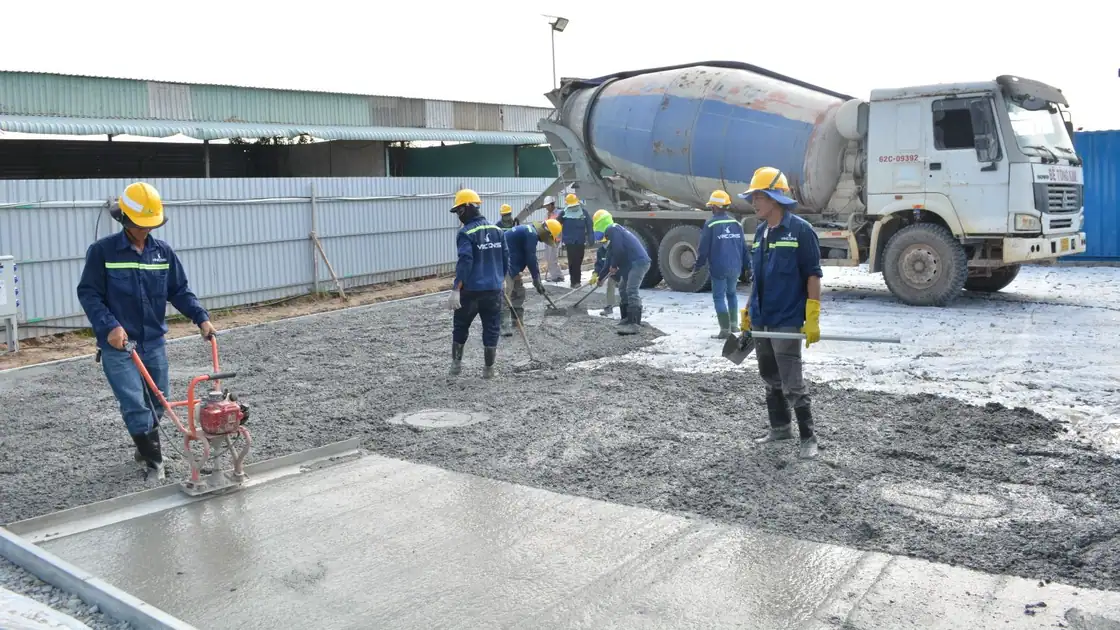
Concrete takeoff examples beyond a simple patio
Each example assumes the stated shape is completely filled with concrete. These are independent examples, not extra concrete to add to the same slab.
Rectangular slab
192 sq ft × 5 in ÷ 324. Check forms and uneven thickness before deciding on a delivery quantity.
Straight continuous footing
36 × 2 × 1 ÷ 27. Deduct known overlaps where footings intersect.
Four round piers
4 × π × (0.5 ft)² × 3 ft ÷ 27. This is gross hole volume before any displaced space.
Which concrete quantity method should you use?
First identify the part of the pour; a single rectangle formula does not cover every form or vertical element.
| Situation | Method or material | Verify before purchasing |
|---|---|---|
| Flat slab, pad or patio | Length × width × thickness | Actual formed thickness and edge details |
| Continuous rectangular footing | Total run × width × depth | Corners, intersections and slab overlap |
| Round pier or post hole | π × radius² × depth | Measured hole diameter, hole count and any displacement |
| Bagged mix | Total cubic feet ÷ labeled yield per bag | Exact product and yield on its technical data sheet |
Calculate concrete cubic yards from slab dimensions
A uniform rectangular concrete slab is measured by its finished length, width and thickness. Enter length and width in feet and slab thickness in inches. The volume formula is length (ft) × width (ft) × thickness (in) ÷ 324. Dividing by 324 converts the mixed feet-and-inches dimensions directly into cubic yards. All measurements should refer to the actual concrete shape, not the outside edge of surrounding excavation.
For example, a patio measuring 15 feet by 12 feet with a 4-inch-thick slab has 180 square feet of area. Its concrete volume is 180 × 4 ÷ 324 = 2.2222 yd³, equivalent to 60 cubic feet. Use the calculator above to change the dimensions. For a detailed explanation of the underlying volume conversion, see how to calculate cubic yards.
Concrete slab thickness chart: yards needed per 100 square feet
Slab thickness has a direct, linear effect on concrete quantity. For the same footprint, a 6-inch layer uses 50% more concrete than a 4-inch layer. The depths in the table are calculation scenarios, not structural recommendations. Required slab thickness, reinforcement, subbase and concrete strength depend on the use, loads, soil and approved plans.
| Thickness | Cubic feet | Cubic yards |
|---|---|---|
| 3 | 25 | 0.93 yd³ |
| 4 | 33.33 | 1.23 yd³ |
| 5 | 41.67 | 1.54 yd³ |
| 6 | 50 | 1.85 yd³ |
| 8 | 66.67 | 2.47 yd³ |
Cubic feet are rounded for display; cubic-yard figures exclude slab edges, depressions and job-specific allowances.
Estimating patios, driveways and walkways without missing sections
For a straightforward patio, measure the inside dimensions of the forms and the finished thickness. A curved patio can be divided into rectangles and circular segments. If the thickness changes, do not apply a single average unless it accurately represents the volume. Calculate each section separately and add its cubic yards.
A driveway often includes transitions, approaches and thicker edges that are absent from a simple flat-slab calculation. A walkway may have steps, ramps or widened landings. Mark those features on a sketch with dimensions before estimating. This prevents both under-ordering and double-counting adjoining portions of the pour.
Concrete footings, grade beams and thickened edges
Footings are three-dimensional elements and need their own width, depth and run length. A rectangular continuous footing can be estimated as length (ft) × width (ft) × depth (ft) ÷ 27. For a 30-foot-long footing that is 2 feet wide and 1 foot deep, the gross volume is 60 cubic feet, or about 2.22 yd³.
When a slab has a thickened edge, count only the volume in addition to the slab thickness already included. For example, if a strip is 12 inches deep overall and the slab volume already assumes 4 inches, estimate the extra strip using 8 inches, not another 12. If footings overlap or join, deduct overlaps to avoid adding the same concrete twice.
Structural footing dimensions should come from approved drawings or the responsible professional. This calculator estimates quantities; it does not specify footing sizes, bearing capacity, reinforcement or code compliance.
Round piers, post holes and cylindrical concrete volumes
For a circular pier, calculate the cross-sectional area as π × radius² using feet, then multiply by the pier depth in feet. Divide the cubic feet by 27 to obtain cubic yards. The radius equals half the measured diameter. A 12-inch-diameter hole that is 3 feet deep has an area of approximately 0.785 square foot and a gross cylindrical volume of about 2.36 cubic feet, or 0.087 yd³.
If a post or other object occupies part of the hole, the concrete volume can be less than the full cylinder. Estimate the displaced volume only when dimensions and placement are known; otherwise treat the full cylinder as a gross estimate. Multiple identical holes can be calculated once and multiplied by the number of holes.
Ready-mix concrete versus bagged concrete
Ready-mix suppliers commonly quote wet concrete by the cubic yard, while packaged concrete is specified by bag weight and its expected mixed yield. Bag weight alone does not tell you the hardened volume. For a realistic bag count, divide total cubic feet by the published yield per bag, then round up to a whole bag.
As one product-specific illustration, QUIKRETE Concrete Mix ↗ provides bag-count estimators, and the manufacturer lists approximate mixed yields for its standard Concrete Mix. Other blends, lightweight products and fast-setting mixes may differ, so use the actual packaging or manufacturer data for the product you purchase.
| Bag size | Approximate mixed yield | Whole bags per 1 yd³ |
|---|---|---|
| 40 lb | 0.30 ft³ | 90 |
| 60 lb | 0.45 ft³ | 60 |
| 80 lb | 0.60 ft³ | 45 |
Based on published yields for standard QUIKRETE Concrete Mix, not a promise for every concrete product. 1 yd³ = 27 ft³.
Worked example: how many 80-pound bags for a concrete patio?
Consider a patio measuring 15 × 12 feet, poured at a uniform 4-inch thickness. Its area is 180 sq ft. The required mixed volume is 180 × (4 ÷ 12) = 60 cubic feet, or 60 ÷ 27 = 2.22 cubic yards. If the chosen 80-pound bag yields approximately 0.60 cubic foot, 60 ÷ 0.60 = 100 bags before allowance.
That result describes an illustrative product yield, not the best purchasing method. For a larger pour, handling, mixing capacity, delivery access and workable placement time can make ready-mix service more practical. Compare total delivered cost and the resources needed for the pour before deciding.
How much extra concrete should you order?
A geometric calculation may miss uneven subgrade, form variation, thickened areas, spillage and material left in equipment. An ordering allowance is sometimes appropriate, but no single percentage fits every job. Instead, check the measured forms, slab thickness at several points, separate footings and the supplier's minimum load and ordering increments.
For instance, a 2.22 yd³ slab may be quoted or ordered in a supplier-defined increment rather than as precisely 2.2222 yd³. The calculator's allowance field lets you model a scenario, but it does not replace reviewing the physical project. Ask the ready-mix supplier how it handles short loads and delivery scheduling.
Concrete cost estimate and ordering checklist
A material-only estimate is the intended purchase volume multiplied by the supplier's quote per cubic yard. Actual project expense can also include delivery or short-load charges, pump or wheelbarrow access, forms, base preparation, reinforcement, labor and finishing. Avoid comparing the price of bagged mix with ready-mix using bag weight; compare mixed cubic feet or cubic yards instead.
Before finalizing the concrete quantity, check the inside form dimensions, thickness variation, footings and piers, expected site access, supplier increments and the mix specified for the application. If the project is structural, or concrete strength, weather placement or curing matters, follow the project specifications and qualified contractor or engineer.
- Confirm the footprint and thickness of every pour section.
- Calculate edge thickening, post holes and footings separately without overlapping volumes.
- Choose ready-mix or bags based on mixed yield, handling and project logistics.
- Get a supplier quote that states cubic-yard quantity, minimums and delivery charges.
- For exact volume conversions, use cubic feet to cubic yards.
Concrete calculation references
Volume conversions use the international yard defined by NIST ↗. Product-specific bag-yield examples are based on QUIKRETE's concrete calculator ↗ and published standard mix data. The manufacturer notes that bag yields are approximate and do not automatically allow for uneven substrates or waste.
Frequently Asked Questions
How many cubic yards of concrete are needed for a 10 × 10 slab at 4 inches?
A 100-square-foot slab at 4 inches thick has 100 × 4 ÷ 324 = 1.2346 cubic yards, or about 1.23 yd³. Check thicker edges, uneven subgrade and the supplier's ordering increments before purchasing.
How much concrete for a 20 × 20 slab at 6 inches?
The footprint is 400 square feet. At 6 inches thick the geometric volume is 400 × 6 ÷ 324 = 7.41 cubic yards. This is a quantity calculation, not confirmation that 6 inches is the appropriate structural thickness.
How many 80-pound concrete bags make one cubic yard?
For a standard mix with a published yield of approximately 0.60 cubic foot per 80-pound bag, one cubic yard (27 cubic feet) equals 45 bags by yield. Always verify the particular product's labeled yield.
Does a concrete slab calculator include footings?
A basic slab quantity only covers the entered footprint and thickness. Footings, thickened perimeters, steps, ramps and isolated piers require separate volume estimates and careful avoidance of overlapping sections.
How do I calculate concrete for a round post hole?
Measure the hole diameter and depth, convert both to feet, and use π × radius² × depth ÷ 27. Multiply by the number of holes, then adjust for known displacement if a post occupies part of the hole.
Should I order concrete by tons or cubic yards?
Ready-mix concrete is commonly ordered by cubic yard of delivered mix. Weight estimates have different purposes and do not substitute for the volume in forms. Use the units specified by your supplier.
Is a fixed 10% concrete waste factor always enough?
No. Actual needs depend on form dimensions, subgrade, pour features, handling and supplier increments. Model an allowance if appropriate, but verify it for the project instead of assuming a universal percentage.
Does this calculator determine concrete mix strength or reinforcement?
No. It estimates geometric volume. Compressive strength, reinforcement, curing, footing design and local code requirements must be determined separately from qualified project guidance.
Relevant Calculators and Guides
Choose a related resource when your next question needs a different measurement, material or purchasing method.